
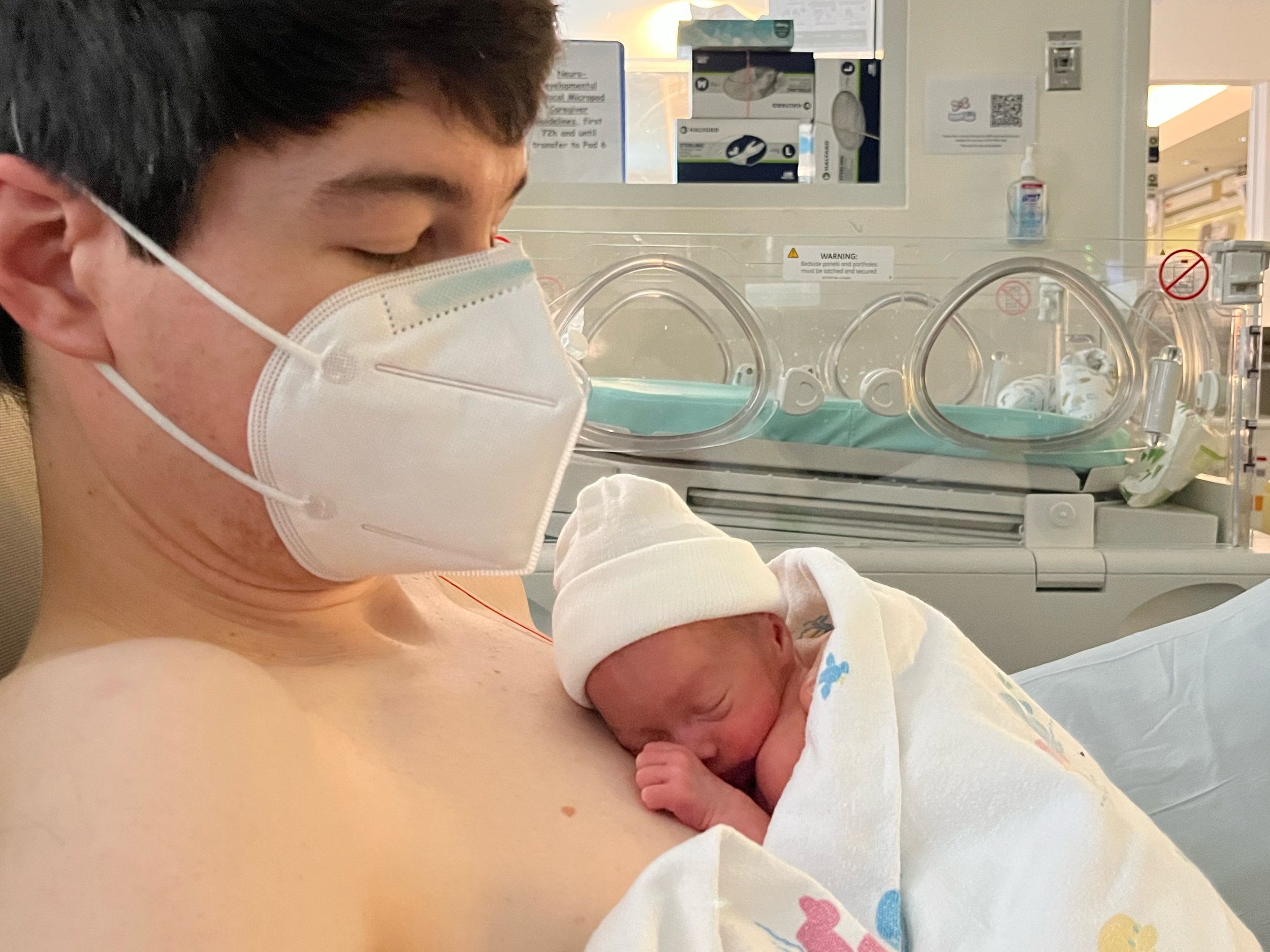
Our daughter, about 1 week old
When our daughter was born unexpectedly early at 31 weeks, we knew that she would need to spend several weeks in the NICU to help her through the complications of prematurity, but we weren’t sure quite what to expect. We were extremely fortunate that she did not have any issues aside from those that are typical of very premature babies. As a result, she was considered a “feeder-grower” after the first couple weeks, meaning that the reason for her continued stay in the NICU was to continue growing and building the skills to eat milk by mouth instead of via a feeding tube.
Over time, we developed a routine for the NICU that helped us stay involved in our little one’s care and gave us the bonding time with her that we wanted. What we share here is a typical day for us in our NICU journey, though everyone’s journey is different.
Schedule for a Typical Day in the NICU
| 10:30 am | Arrive at NICU |
| 11:00 am | First care session |
| 11:15 am | Kangaroo care (Bryan) and pump (Holly) |
| 1 pm | Lunch |
| 2 pm | Second care session |
| 2:15 pm | Kangaroo care (Bryan) and pump (Holly) |
| 3:30 pm | “Us” time |
| 4:45 pm | Pump |
| 5 pm | Third care session |
| 5:15 pm | Kangaroo care (Holly) |
| 7 pm | Grab to-go dinner and head home |
This gives the general idea of how we spent our time at the NICU. Although the care session times were consistent, there was some variability in the timing of the other activities.
Unscheduled Meetings
A major reason for the variability is that it was common for people to stop by unannounced to meet with us. For example, an occupational therapist might drop by twice per week to assess our little one and teach us new skills like infant massage. Likewise, social workers, speech-language pathologists (for feeding training), doctors asking us to participate in research studies, reading program reps, infant safety specialists, and others would come by at random times. We found this a little challenging since it sometimes meant that, in order to meet with the person, we’d have to choose between eating lunch or participating a care session, for example.
Arrival at the NICU

Holly carrying pumped breast milk in a cold pack
When first arriving at the NICU, we’d check in at the front desk of the NICU and put our phones in plastic bags as per policy, to limit the spread of germs. We’d then head over to the pod where our daughter was located, and carefully wash our hands. Our NICU was organized into several different groupings of patient “beds” (incubators and bassinets), and each group was called a “pod.”
When we got to our pod, we’d go peek at our little one, speak to her (while she slept) briefly, and then meet our nurse for the shift. The nurse would give us a quick update on our daughter’s health, including any major notes from the overnight nurse.
Before forgetting, we’d hand off the breast milk to our nurse, who would put it in the fridge for us.
Our nurses were amazing and very helpful. They taught us all the essential skills we needed as new parents and were great coaches.
Something that we found challenging, though, is that we had a different nurse almost every day. Over the course of our NICU stay, we might have had 25+ different nurses just during the daytime shifts. Just once we’d started getting to know a nurse, we’d get a new nurse. This also meant that the new nurse would sometimes misinterpret some of our daughter’s behaviors at first until spending more time with her.
What are rounds?
The medical team would meet for rounds each day at the “bedside” (incubator-side/bassinet-side) to review our daughter’s health status and decide on any changes to her medical plan. The team usually consisted of a neonatologist, a resident/fellow, an NNP (neonatal nurse practitioner), our nurse for the day, and sometimes a nutritionist and respiratory therapist.
The team would “round” (stop by our bedside) at different times each day, but we were always encouraged to participate if we were there at the time. We appreciated hearing their updates and having the opportunity to ask questions about our daughter’s care. We often wanted to ask if certain symptoms or behaviors were “normal,” and the team always took time to answer our questions.
What happens during a NICU care session?
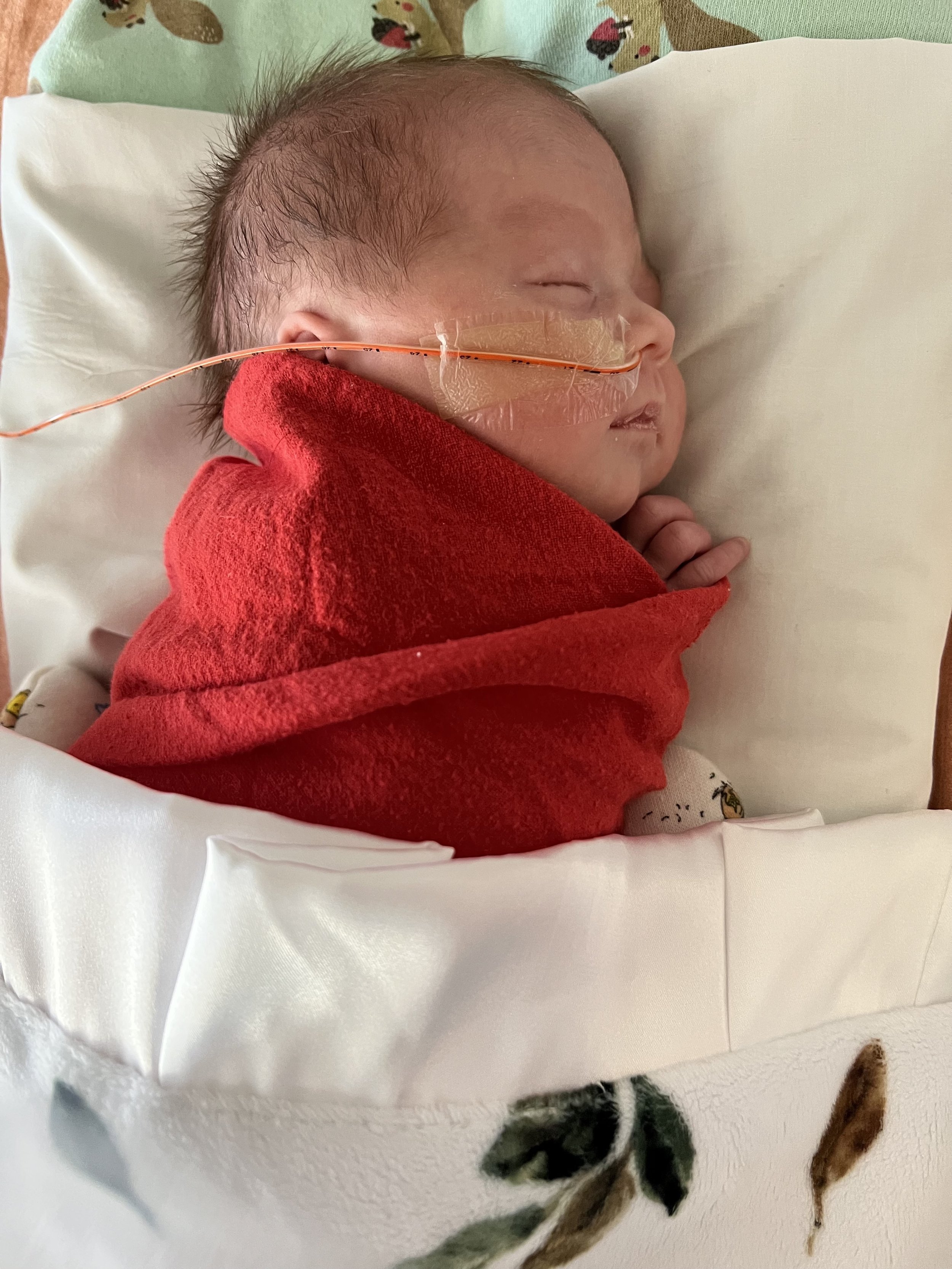
Our little one in her NICU “nest”
There were 8 care sessions each day. The activities during a given care session changed over time as our little one progressed. At first, when she had CPAP for respiratory support, a respiratory therapist would come and change out the adhesive strips on her nose during care sessions. Later, care sessions only involved a temperature check, diaper change, oximeter rotation (moving the blood oxygen saturation sensor from one foot to the other), and feeding.
We were encouraged to participate in the care sessions, and they became both a bonding time and a helpful training time for us to learn how to take care of our newborn. For the first couple weeks, our nurses led the care sessions, and we helped out by comforting our little one. I was surprised that even in the first few days when our kiddo hated diaper changes and all the “messing with her” that the nurses had to do, we were able to help her calm by speaking to her and placing one hand on her head and another at her feet. Care sessions felt daunting to us at first because she was so tiny and fragile. We had to be careful even when changing her diaper, to avoid injuring her tiny hips!
Once we were comfortable with everything needed at the care sessions, we’d take her temperature, change her diaper, and move her pulse ox to the other foot ourselves, and then let our nurse know that we were ready for the feed to be hooked up to the feeding tube.
Something that we didn’t take to heart until toward the end of our NICU stay is that self care is really important. We wanted to be at as many care sessions as we could, but we also had a lot going on outside of visiting our daughter in the NICU. As a result, we’d try to cram in all the other things in the evenings and mornings before going to the NICU. At some point, we realized that sleep was really important and that we were more able to sleep while she was in the NICU than once she would come home. That realization helped us take some mornings as recovery time, knowing that the nurses would take great care of her in our absence.
What is kangaroo care?

Holly holding our little one skin-to-skin, a couple weeks after birth
The highlight of each day in the NICU was kangaroo care. The practice of kangaroo care—holding your infant skin-to-skin against your bare chest—was a really meaningful way for us to interact. We weren’t sure if our little one would be healthy enough to be held, but even in the first several days when she had CPAP for respiratory support, IVs, and a bunch of sensors, the nurses helped us set up for skin-to-skin time. There’s something really special about feeling her tiny little body breathing against your chest.
Initially, nurses recommended that we do kangaroo care only once per day, for at least one hour at a time. That’s because moving her around and detaching and reattaching all the lines and sensors was a little stressful to her underdeveloped nervous system and caused her to burn calories that we were trying hard to conserve. Once she grew and developed more, we were allowed to hold her skin-to-skin after each care session.
Pumping Time in the NICU

A breast pump in the NICU
Since our little one hadn’t yet developed the skills to breastfeed (and that would have taken too much energy for her for the first several weeks), Holly pumped milk that could be given to her via a feeding tube at each of the 8 daily care sessions. Pumping is an exhausting, time-consuming activity that can nearly take over one’s life, so kudos to all the folks out there who pump for their little ones!
The NICU had breast pumps that lactating parents could borrow while at the hospital. Since there was a limited supply of pumps, I came to think of them as treasure, and I’d go on a treasure hunt to find an available pump somewhere around the NICU when Holly needed to pump. At times, there was also competition for use of the sinks, so I’d scout out which sink was free for me to wash pump parts.
Holly pumped several times each day while we were at the NICU. Usually, I’d hold our little one for kangaroo care for the first two care sessions while Holly pumped, and then Holly would pump before the third care session so that she could do kangaroo care that time. The pumping schedule was sometimes thrown off by unscheduled meetings with various folks who stopped by to do assessments our talk with us about care.
In the early days of our NICU stay, we’d prepare for a pumping session by setting up screens around Holly’s chair. If someone came by to meet with us, I’d let that know that Holly wasn’t available. We tried to be really discreet. It didn’t take long before all that went out the window. After several days, Holly decided that the screens were a hassle and that all the medical staff had probably seen boobs before. 😂
Meal Time
The hospital had a couple different cafeterias, and we were fortunate that the NICU provided a meal voucher to breastfeeding parents for up to three meals per day in the hospital. We were pretty impressed with the cafeteria food. This wasn’t what I’d pictured for hospital food. There was excellent variety: curries, casseroles, pastas, and vegetarian- and vegan-friendly options. They also had an extensive grab-and-go section that we used in the evenings on our way home.
“Us” Time

A view of the Portland skyline and the aerial tram just outside the hospital
In the afternoons, we liked to take some time to ourselves before returning to the NICU for the third care session. Holly and I would typically go for a walk around the hospital, or, as she recovered more from the C-section, we’d walk around more extensively outside. This was a great time for us to get some exercise and debrief after what was often a stressful first part of the day.
Conclusion
Our time in the NICU was exhausting. Although we were fortunate that our kiddo didn’t develop any major complications, there were plenty of days when we felt discouraged. Her development often felt like two steps forward and one step back. She’d reach a new milestone, such as having her CPAP device removed, and then she might have a series of apneic episodes requiring stimulation to get her to start breathing again. Maintaining a broader perspective and keeping up our hope that the long-term trend was for her to continue improving, took a lot of emotional energy. We’re extremely grateful that she eventually met all her development goals and was discharged from the NICU. If you’re on your own NICU journey right now, we feel for you and know that it can be tough. Keep up the hope! ❤️
You may also be interested in this article about things that we didn’t expect during our NICU journey.

 Our Portland Life
Leave a comment