
Exclusively pumping is unlike anything I’ve done in my life, but if I had to relate it to something, it would be the Dead Arm Hang. In middle school, I briefly held the gym class record for that somewhat unglamorous fitness test, an exercise that requires hanging by the arms for as long as possible. It’s not really about muscle. It’s more about tolerating pain.
Exclusively pumping is likewise a test of grit, a long exercise in attrition. I will say that exclusively pumping is more worthwhile than the Dead Arm Hang–it’s definitely better to end up with breast milk for your effort!
This article isn’t a how-to on exclusively pumping, or a discussion of breast milk vs formula–there’s plenty written on those things already. Instead it shares my experience exclusively pumping, a raw and real story of successes, failures, tears, self-doubt, guilt, love, and, of course, milk.

What is Exclusively Pumping?
A quick definition before we dive in: Exclusively pumping means expressing breast milk with a breast pump as the primary means of feeding a baby. Exclusive pumpers usually store the expressed milk and then bottle-feed it to their babies.
Although “exclusive” is in the name, many exclusive pumpers supplement with formula. That’s partly because of variability in breast milk supply from person to person, and partly because there’s inherently some wasted milk when bottle-feeding. Babies often don’t finish bottles, and health department guidelines recommend against saving leftover breast milk after a baby has started drinking from a bottle, so exclusive pumpers usually need to provide more milk than their babies actually drink.
Getting Started with Exclusively Pumping
While exclusively pumping is occasionally a first-choice feeding method, most of us landed here accidentally…and often abruptly. Here’s how it happened for me.
“I have news for you, my dear,” said my OB. “You’re 4 cm dilated, and I can feel the baby’s feet. I’m going to have to send you to Labor & Delivery, in a wheelchair.”
In that moment, my entire life changed. But as I was wheeled through the hospital, I didn’t think so. I felt certain there had just been a mistake. This was a routine prenatal appointment, 9 weeks before my baby’s due date, and I felt…entirely normal. From everything I’d heard about childbirth, labor would be excruciatingly painful–definitely not something that would be difficult to notice.
And yet, here we were. I never found out why it happened, and I never felt any labor pains, but my baby arrived two days later. Some things in life are just weird and random. As they say in my favorite book series, “The wand chooses the wizard, Harry.”
The NICU became our world. Bryan and I, and often my mom, would spend long days holding our little girl. We navigated gingerly around wires and tubes, eyes anxiously flicking to her monitor screen whenever the blare of a low oxygen alarm sounded down the ward.
“Phew!” I’d think. “It wasn’t her alarm.” Then I’d feel instantly guilty. Someone else’s baby was in distress.
The NICU is probably the only place where exclusively pumping is the norm. It was so common that after a while, I stopped bothering to hunt down and put up privacy screens. I just pumped at my baby’s bedside, amid the general tumult of doctors, nurses, and the families of the other three babies in the pod coming and going.
Exclusively pumping is so common for preemies because the reflex that enables drinking milk develops in the womb around 34 weeks’ gestation. Babies born earlier (like mine) can’t drink milk independently until they reach 34 weeks–and even then, it’s a long, slow learning process. Most younger preemies are fed via feeding tube.

Even after preemies learn to drink, they’re usually mostly bottle-fed because breast milk isn’t calorically dense enough to mimic the nutrition they would have gotten in the womb. Scoops of powdered preemie formula are typically added to pumped breast milk to close the gap.
When a nurse first showed me how to express breast milk, in the recovery area after my c-section, I thought it was like a strange magic. I’ve always been so flat-chested that I was secretly certain my boobs would not produce milk. So I was shocked and thrilled when I saw the first tiny drops of colostrum, and we caught them in a little vial to give to our baby.
“So, you just do this eight times per day,” said the nurse.
I nodded, eager to get started.
It wasn’t until later that I realized how very difficult to follow those very simple instructions would be.
It turned out I needed to pump for 30 minutes per session to approximately meet my baby’s milk needs. That’s 4 hours per day on the pump, not counting related tasks like washing pump parts and bottling and labeling milk. And pumping has to happen around the clock, so there’s no knocking it out at the start of the day. You just pump continually with little breaks in between…for as long as you last. Here’s what that looked like for me.

Exclusively Pumping: A Day in the Life
I sank to my knees on the floor beside the bed. For the moment, miraculously, my little one was asleep in her crib, small rhythmic snuffling noises confirming that she was fast asleep. I could almost count on my hands the number of times we’d achieved a crib nap.
My eyes moved from the crib back to the bed, focusing automatically on the pillow. Its warm folds drew me toward it like a magnet. But when you exclusively pump, you don’t sleep when the baby sleeps. You pump.
Silent tears leaking onto my cheeks, I tiptoed to the kitchen, where most of the countertop was hidden under blue plastic bins brimming with pump parts. The steady “whoosh” of the dishwasher ensured the imminent delivery of more freshly cleaned pump parts.

I shuffled over to one of the bins and began assembling the pump parts–fitting together two sets of collection bottles, little silicone backflow preventers, funny plastic gooseneck connector pieces, and flanges.
I padded into the living room and settled into the couch. By the blue light of the pump, I registered the time: 3 AM.
The steady “unz-unz” sound of the pump soon filled the darkened room, and milk began to spray in little streams into the collection bottles.
Pump now in action, I opened my laptop to the article I’d been writing. This was the way I got work done these days, in little slices and always with the pump.
The baby monitor beside me crackled, and I squinted at the video. My little one was stirring. Before I could get to my feet, her cries had zoomed under the door and filled the room. The timer on the pump showed eight minutes of the 30-minute pump session had elapsed.
Pump in hand, I hurried into her room, the “unz-unz” of the pump just audible over the white noise machine.
“It’s okay,” I coaxed, bending over the crib. “You’re okay.”
The crying escalated.
I broke into a soft lullaby, the words instantly consumed by the escalating wail. I laid a reassuring hand on her chest.
There was no effect.
Something warm spattered onto my arm, and I jolted upright out of the crib. Milk had spilled out over the tops of the collection bottles. In the faint glow of the night light, I could see little pools of milk blooming on the hardwood floor.
Whoever said not to cry over spilt milk clearly never pumped breast milk. There’s something almost animal about the feeling, a peculiar anguish when you realize you traded sleep or snuggles or a shower for breast milk, and the milk is gone.
One time, I returned to my freshly pumped milk bottles from a quick bathroom break…to find a fruit fly swimming in the milk. After an internal struggle over whether to keep the milk, I reflected, while watching the milk swill down the drain, that the emphasis on sterile milk storage probably precludes inclusion of a fly that feeds on rotting fruit.
Back in the present, my little one was crying in earnest now, big, reverberating wails that I could feel in my very bones. Quickly unhooking the milk bottles, I brought her into my arms, where she burrowed into my shoulder and soon settled to sleep. I sat up holding her, as milk leaked slowly from my insufficiently pumped breasts and soaked into both of our clothes.
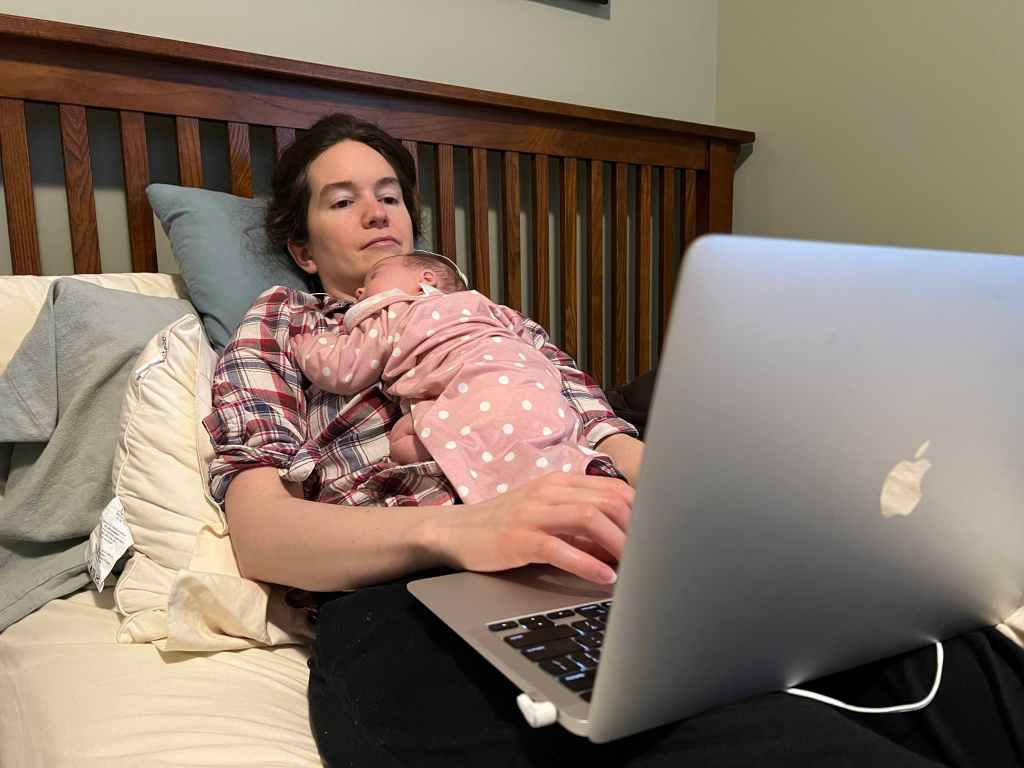
This was the reality of exclusively pumping for me–the constant choice between comforting my baby and producing milk for her. Everyone’s supply is different, but I didn’t have extra milk. If I missed a pumping session, she would have formula instead. When I had to choose, I would choose comforting her over pumping. Some exclusive pumpers make the other choice, and there’s uncertainty and guilt on both sides of the decision.
While using formula is common (and we eventually switched our little one fully to a hypoallergenic formula when we learned she had a dairy protein allergy), there’s an enormous societal pressure to breastfeed. Even walking down the street, the occasional passerby would ask me, “Are you breastfeeding?” The weekly baby newsletter from my hospital almost always included articles with headers like, “Congratulations for continuing to breastfeed!”–even though obviously not all the newsletter recipients made that choice.
What isn’t talked about is that breastfeeding is a lot harder in certain circumstances than others. Before living it, I vaguely pictured an idealized bonding experience, like the breastfeeding emoji on my phone (🤱). When people ask, “Are you breastfeeding?,” they don’t picture leaving a baby to cry while you cry on the floor with a breast pump…or leaking breast milk all over your baby while you feed them a bottle of formula because they were hungry before you finished pumping. But this is the cost of breastfeeding for some of us.
My little one’s severe reflux meant that for months she would only sleep while held, so I took night shift and stayed up holding her. Bryan and extended family (when in town) helped a lot. They would care for her during the day while I pumped milk and slept in chunks around pump sessions. I became a sort of specter of myself, a shadow who rarely saw the sun, but who pumped milk, fed baby bottles, held my baby, and slept in so many tiny pieces. Sometimes I felt like a cow, there to produce milk while others took care of my baby.
When Bryan went back to work from parental leave, and extended family went home, the sleep deprivation consumed me. I felt like I was watching myself exist, willing my body to act on instructions I gave it through a sort of haze. I started breaking down into tears multiple times per week.
Eventually we settled into a routine–I would nap in the evening after Bryan got home from work. With a little more sleep, I began to heal…but I now saw more of the pump than Bryan.
This experience isn’t universal, but it’s common for exclusive pumpers. While holding my sleeping baby, I’d scroll the posts on Reddit (r/ExclusivelyPumping) for tips, tricks, and solidarity. I can’t recommend that community highly enough if you find yourself exclusively pumping. There’s a peculiar camaraderie to joining a community of thousands of strangers all over the world, who anonymously breathe words into the shared struggle, the tears and triumphs, and who celebrate other strangers meeting goals or realizing their goals have changed along the way.
Exclusively pumping is one of the hardest things I’ve ever done. If I were in the same shoes again, I might make the same choices–I don’t know. It’s given me a new appreciation for perseverance, love, sacrifice, acceptance, and the messy, gray choices in life. The choice of how to feed a baby is certainly both deeply complicated and deeply personal.

 Our Portland Life
Leave a comment