
This is not intended as medical advice. If you have questions about newborn care, contact your child’s pediatrician.
This post contains affiliate links, so we may earn a small commission from qualifying purchases.
“Oh no, not already,” I thought, as our daughter started squirming and mouthing her hand. Just 30 minutes earlier, she had finally fallen asleep after struggling to eat. I’d grown to dread feeding sessions, and I was concerned that she might start to feel the same way soon.
Feeding our baby wasn’t always this hard.
For about 6 weeks in the NICU, she’d gotten food via a feeding tube. Now, she’d been home for a while and was eating from a bottle. Although we did some breastfeeding, her circumstances necessitated fortifying most of the breast milk with formula to make it more calorically rich.
When we first came home, she ate well. We’d wake her up about every 3 hours, offer her a bottle, and she’d sleep again until the next time. Feeding sessions were usually about 30 minutes long, and she generally finished the bottle.
Straining, arching the back, and other reflux symptoms
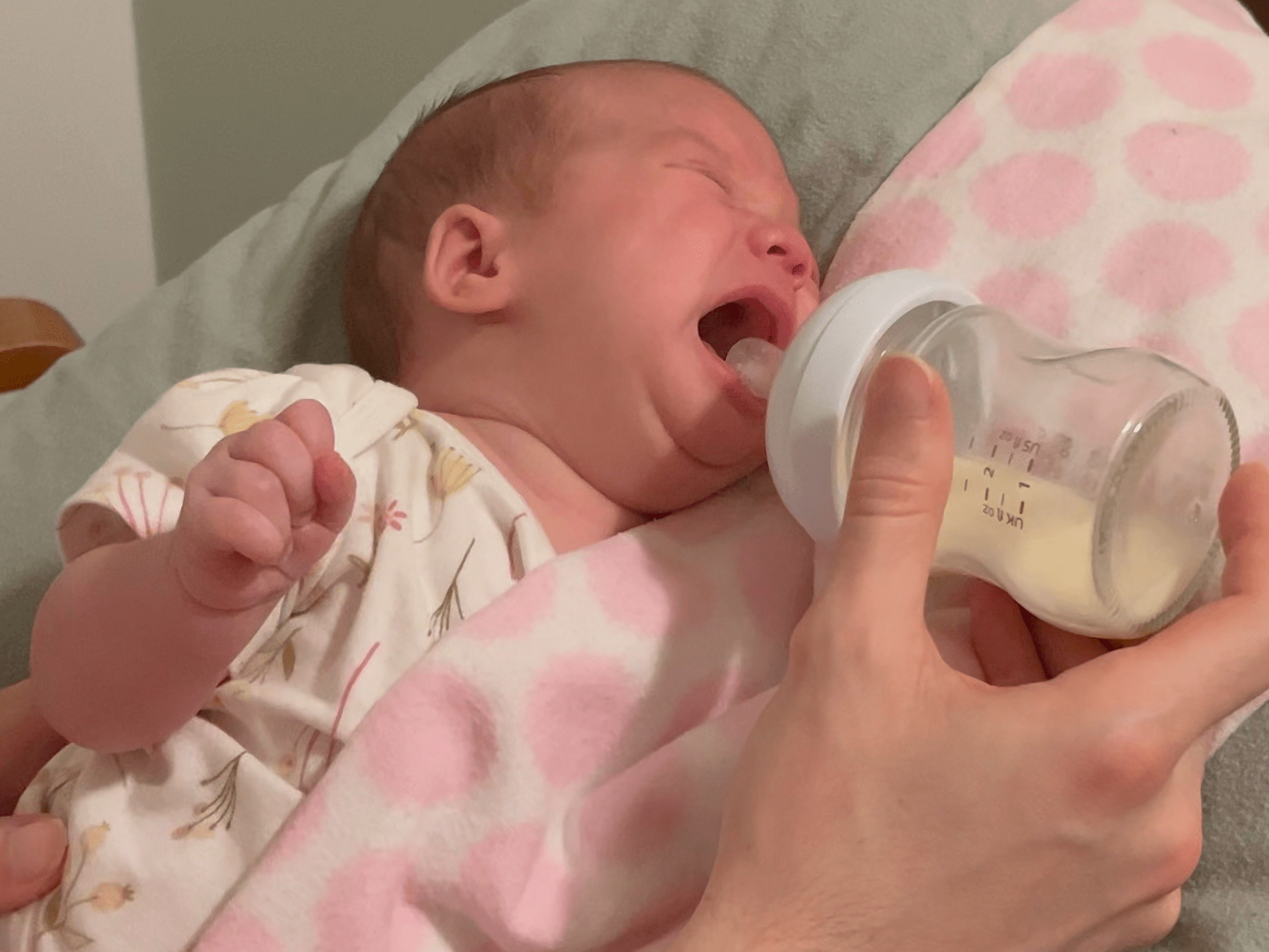
When she was about 10 weeks old (1 week adjusted), feedings became a struggle. After eating a small amount, she’d start making straining noises, arch her back, pull her head way back, and stiffen her legs. Once she started doing this in a given feeding session, the behavior would continue for an hour, maybe two or three hours, until she had struggled and strained so much that she’d fall asleep. However, she was still hungry because she’d been awake so long and wasn’t able to eat efficiently.
We were concerned that she was struggling so much to eat and were worried that she might develop a feeding aversion. We reached out to our pediatrician and discussed the situation. She observed a feeding session and determined that the symptoms looked like reflux.
We tried to redux reflux by exclusively feeding breast milk.
Our pediatrician referred us to a swallowing specialist and a nutritionist, who recommended that we do a one-week trial of feeding breast milk only (i.e. discontinue the fortification) to rule out a possible sensitivity to the formula. That made the logistics of food prep soooo much easier! Instead of having to mix breast milk with formula, we got to use breast milk, which saved time and dishes. Another benefit is that we could leave bottles of breast milk at room temperature for up to 4 hours instead of only 2 hours (formula has a shorter lifespan at room temperature than breast milk), which meant that we wasted less milk. The best part was that we were able to do more breastfeeding, which meant less pumping, fewer dishes, and saved time!
After a few days, we noticed some changes in our little one’s behavior. She was still straining through the feedings and showing reflux symptoms, but she was also now very sleepy. She’d become so sleepy that she couldn’t stay awake to eat much. Instead of consuming a higher volume of milk to compensate for the lack of fortification, she was eating less than before.
We weighed her after a week, and she had barely gained any weight. Her reflux symptoms had not improved, and she was borderline lethargic. We resumed fortified feeds and moved on to the next idea for addressing her reflux.
How we treated our baby’s reflux
At the next appointment about our baby’s feeding problems, our medical team recommended that we try a feed thickener—specifically Gelmix—to reduce the severity of the reflux. The hypothesis was that using a feed thickener with the milk would make the milk less likely to push back up through the esophagus and cause irritation while eating.
We began using Gelmix with the fortified breast milk for every feeding session. Since there were additional bottle preparation steps to use Gelmix, I was not a fan at first. After several feeding sessions with Gelmix, though, we realized that our little one was not straining anymore when eating!
After using Gelmix for a week, we saw a massive increase in the volume that our little one consumed: she ate about 32% more volume! With the decrease in straining while eating, she managed to eat much more efficiently and seemed much happier. I was really impressed with Gelmix!
Downsides of using Gelmix feed thickener
Unfortunately, using Gelmix has some disadvantages. Since it thickens the milk (which is its purpose), the milk can be harder for the baby to suck through the bottle’s nipple. We had to get a faster-flow nipple to account for that. Also, since Gelmix doesn’t mix into milk at refrigerated temperature or room temperature, it’s necessary to heat the milk to about 100 degrees F before mixing the Gelmix into it. Milk with added Gelmix can increase in thickness if refrigerated, so our swallowing specialist recommended against mixing milk with Gelmix in advance and refrigerating it.
The worst thing about using Gelmix is that the bottle has to sit at least 5 minutes after mixing the Gelmix into the milk, so that it can become thick. This means that when we have a very hungry, crying baby who wants a second bottle, we have to then tell her, “Sorry, you’ll have to wait a few minutes for us to heat the milk and then 5 more minutes for the milk to thicken after we add the Gelmix.”
Where to buy Gelmix feed thickener
Be sure to consult your pediatrician before changing your child’s feeding plan.
Here is where you can buy Gelmix feed thickener.
Note that we may earn a commission if you choose to purchase from this link.


 Our Portland Life
Leave a comment