

This is not intended as medical advice. If you have questions about newborn care, contact your child’s pediatrician.
This post contains affiliate links, so we may earn a small commission from qualifying purchases.
We had read books and taken classes on how to care for a newborn, but as with most things, experience is the best teacher. After diving into the journey with our little one, here are five surprising things we found about taking care of a newborn.
#1: Newborns don’t just sleep when tired.

We’d heard that newborns sleep most of the day—between about 16 and 20 hours for most babies. It is true that our little one sleeps a lot. However, we’ve had a lot to learn about how to manage an overtired newborn.
How long do newborns stay awake?
Our newborn has a wake window of about 20 to 60 minutes, though this can vary by baby. After being awake for roughly this duration, she’ll yawn and start looking sleepy. When we’re lucky, she’ll gently drift off to sleep and stay asleep. However, that’s not always the case.
How do I get my overtired newborn to sleep?
It’s common for her to become overtired. When she’s overtired, here are her symptoms:
-
becomes hyper or seemingly wide awake, with jittery movements
-
increased irritability and short cry-outs
-
difficulty latching onto a nipple even if hungry
Once our baby is overtired, it’s very hard for her to fall asleep. I found this counterintuitive (and frustrating at times). The best way to help her sleep when she’s overtired is to swaddle her tightly (this sleep sack swaddle works great!), offer the pacifier (may need to repeatedly offer it), turn off all the lights, turn on white noise, hold her, and walk around the home with her. Persistence is often required for this to work. Sometimes, she’ll start falling into a light sleep after several minutes of this, but it sometimes takes 30+ minutes. Wearing her in a baby carrier and walking around a dimly lit home sometimes works as well, though it also requires persistence because she resists the carrier at first when she’s overtired.
Don’t discount hunger as a possible reason your baby won’t fall asleep. We’ve seen plenty of times when she’s eaten well but then has become overtired and started rooting again.
At first, we didn’t believe that she could still be hungry since it’s difficult for her to eat when she’s overtired. For example, when overtired, she’ll sometimes pull back off of the nipple, cry with the nipple in her mouth, get only a shallow latch, or lick the nipple and suck only weakly while still acting desperately hungry. Despite having trouble eating when she’s overtired, she sometimes is actually hungry, which contributes to her having trouble falling asleep. Once she eats more, she’ll often easily fall asleep.
#2: Newborns don’t play with toys.

A few days after we came home from the hospital, I learned an important lesson about playing with a newborn. Our daughter had just finished a bottle and was still wide awake, looking around curiously. This seemed like the perfect opportunity for some play time. I reached over to a nearby table and grabbed the brightly colored lion rattle that she’d been gifted. Grasping it firmly, I shook it in front of her face to demonstrate the rattle noise. I looked over, hoping to see a smile. Her eyes were as wide as I’d ever seen them, her eyebrows were way up, and her mouth was an expression of serious alarm. As I realized that this was not, in fact, her favorite activity, she broke into hiccups.
That’s when I learned that newborns are easily overstimulated. Loud noises, bright lights, and other big sensory experiences can cause them to become overstimulated, leading to stress and irritability.
We’ve since learned other forms of play that are appropriate for the first few weeks of life. Reading a book and pointing out the pictures is one of our favorites. Placing a mirror next to a newborn is another good way to engage them. Even talking quietly to her while she can see our faces is a form of playing with her.
Over time, newborns’ interest in other forms of play broadens as they develop more. In several weeks, that rattle really will be her favorite toy!
#3: Bath time can be stressful.

Feel-good advertisements often show a baby cooing in a bathtub, smiling at mom. As we discovered, there’s a reason that those videos show older babies instead of newborns!
We had everything planned out for the first bath time at home. The baby tub was filled with warm water, a thermometer shaped like a harbor seal bobbed happily along the surface of the water, showing 100 degrees F, baby shampoo and cotton balls were at the ready, and a towel and clean outfit were laid out for afterward. It all started well: we gently picked up our little one, removed her outfit and diaper, wrapped her in a thin cloth, and carefully lowered her into the tub. She looked surprised and curious. One of us supported her head and made sure her bottom didn’t slip off the hump in the bottom of the tub, and the other began meticulously cleaning every nook and cranny.
Suddenly, her expression went from curiosity to concern. The cries came shortly thereafter. We had finished washing the armpits and neck but had a long way to go. Our little one began vigorously mouthing her fist, alternating between that and wailing. We cleaned between the toes. Wailing. We cleaned the diaper area. More wailing and intense squirming. Finally, we rinsed her head and decided it was time to end the bath.
For the next three hours, she acted desperately hungry but ate little of what we offered her. Wide-eyed and frantic, she rooted madly and waved her arms. Eventually, we managed to calm her down so that she could eat effectively, and she fell asleep. We dreaded bath time for the next few weeks until we learned how to make it easier (see our tips here on making bath time with your newborn easier).
#4: Stroller rides aren’t necessarily calming.
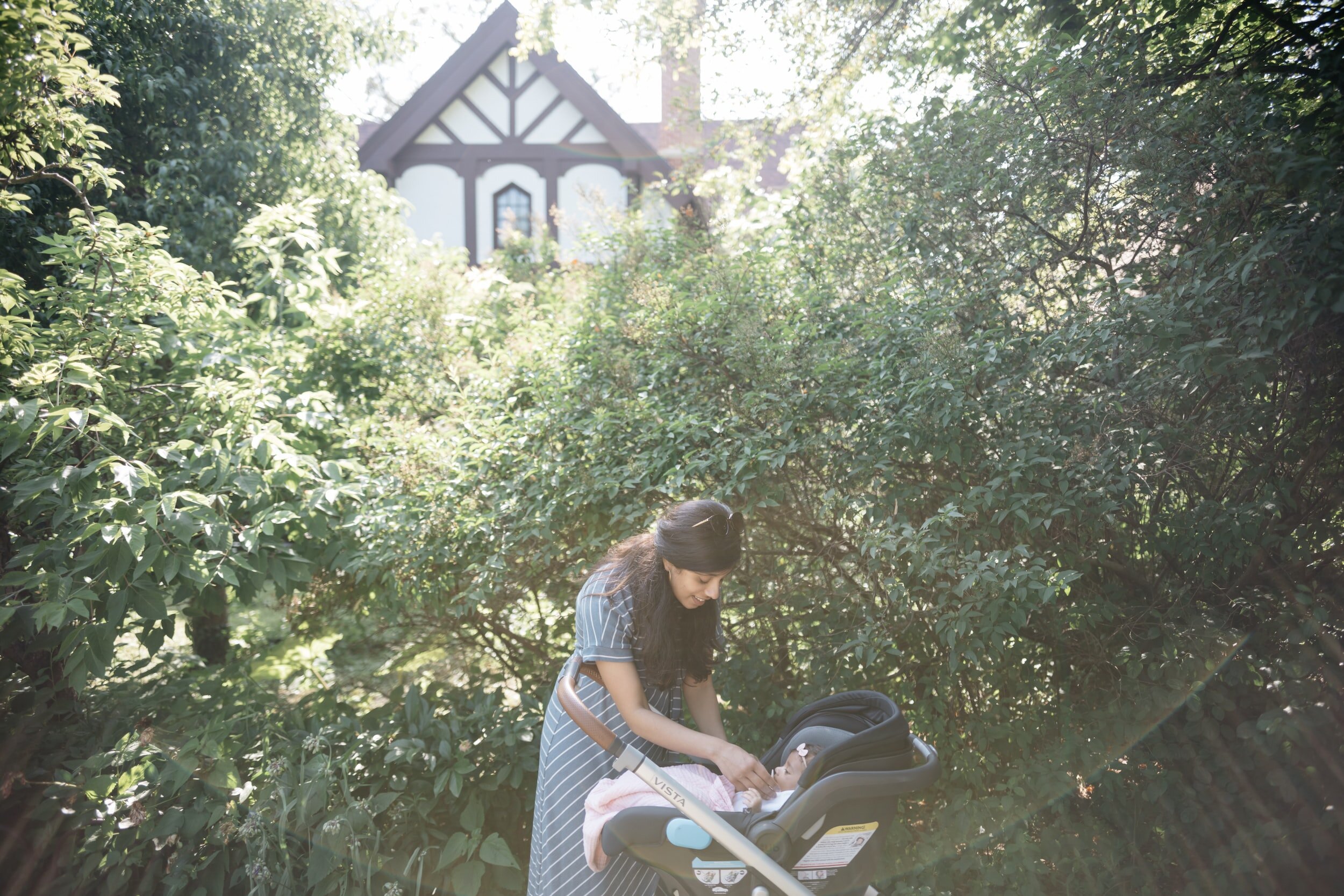
Our daughter had a lot of trouble sleeping in her crib at first, due to significant reflux and gas. As a result, we held her in shifts around the clock while she slept, lying on us. After a couple weeks of this, we were desperate to get outside for exercise. As a preemie, she was still too small to fit well in the carrier that we had, and we hadn’t gotten the hang of wearing her in a sling/wrap since it seemed like her neck always ended up in some strange contortion. We decided that a stroller would be the solution because whichever one of us was awake could walk around the neighborhood with her in the stroller while she slept, instead of just lying on the bed for hours on end.
After hours of research, we chose a stroller and ordered it second-hand from an online shop. We eagerly anticipated its arrival over the next few days, picturing tender moments as we pushed our little one along in the stroller. Finally, the stroller arrived!
Our first outing went pretty well. Our little one drifted in and out of sleep as we walked around the blocks near our home. We considered it a success.
The second time we took the stroller was, unfortunately, more typical of our experience since. We tucked her into the stroller seat, reclined to the “newborn” position, and she fell asleep. As we started walking along, she awoke and was suddenly wide-eyed and nervous looking. As we considered continuing since she might just fall back asleep to the gentle motion of the stroller, she began crying. We offered the pacifier, which she promptly spat out. It didn’t seem like she was going to just fall asleep peacefully now.
We hurried back to our home and held her, shushing and bouncing, trying to help her fall asleep. After another hour of the same, she had finally calmed down enough to eat and fall asleep.
In our experience, stroller rides take practice and good timing. Our daughter grew more accustomed to riding in the stroller over time. We also learned some tricks to make stroller rides easier with our newborn: we found that 1) she needed to be very well fed beforehand and 2) evening was easier since it wasn’t as bright and potentially overstimulating to her.
#5: Hunger cues don’t always indicate hunger.
Sometimes, we feel like our daughter gives us mixed messages. When she shows hunger cues, such as rooting, sucking on her fist, or crying, it does not always mean that she’s hungry. While these cues can indicate that she wants to eat, other times, these signs are her way of expressing a different need: the need for comfort.
Newborns find sucking incredibly soothing. It’s a reflex they’re born with, and it helps them feel secure and content. If your baby starts showing signs of what you think are hunger cues shortly after a feeding, they may not necessarily be hungry again; they may just want the comfort of sucking. In such cases, we find that swaddling and offering a pacifier can help.

 Our Portland Life
Leave a comment